
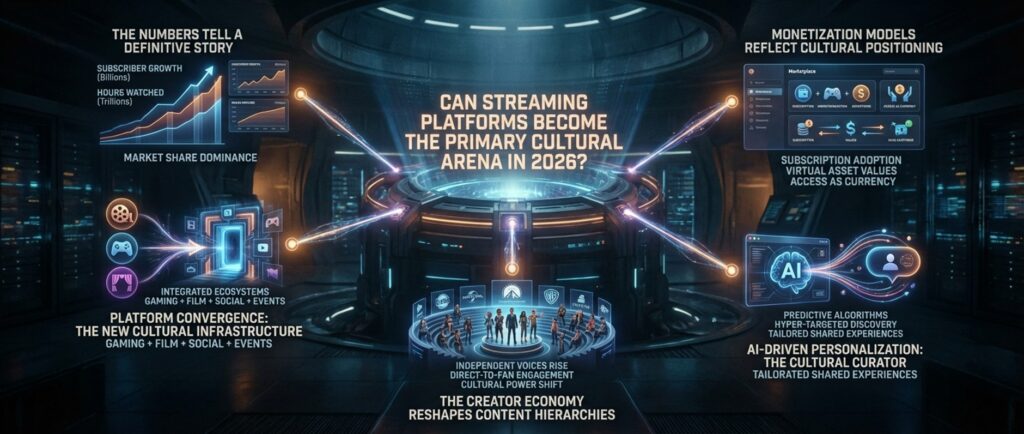
The data suggests we are witnessing a historic inflection point in media consumption. As of February 2026, streaming platforms are not merely competing with traditional media – they are fundamentally reshaping how culture is created, distributed, and consumed.
Streaming is crossing the threshold from an alternative entertainment option to a dominant cultural infrastructure. This transformation carries significant implications for content creators, media companies, and audiences worldwide.
The Numbers Tell a Definitive Story

Streaming platforms are projected to surpass 50% of US TV viewing for the first time in summer 2026. This milestone represents more than a statistical achievement; it signals a fundamental shift in where collective cultural attention resides. Consider the following breakdown:
Key Viewing Statistics (2026):
- Projected streaming share of US TV viewing: 50%+ (Summer 2026);
- YouTube alone: Expected to surpass combined broadcast viewership (Summer 2026);
- Global streamed content market valuation: USD 670+ billion (2026 estimate);
- American households with at least one streaming subscription: 85%;
- Late 2025 streaming viewership baseline: 47.5% of US audiences;
- Late 2025 broadcast/cable viewing: 41.6% of US audiences.
The trajectory is unmistakable. Streaming viewership climbed from 47.5% in late 2025 to a projected majority share by mid-2026 – a growth rate that traditional broadcasting simply cannot match. This acceleration reflects changing consumer preferences across all demographic groups.
The following table compares key metrics between streaming and traditional broadcast viewing:
| Metric | Streaming Platforms | Traditional Broadcast/Cable | Timeframe |
| US TV Viewing Share | 50%+ (projected) | 41.6% | Summer 2026 |
| Late 2025 Baseline | 47.5% | 41.6% | Late 2025 |
| Household Penetration | 85% with at least one subscription | Declining | Early 2026 |
| Market Valuation | USD 670+ billion | N/A | 2026 estimate |
| YouTube vs. Broadcast | Surpassing the combined broadcast | Being surpassed | Summer 2026 |
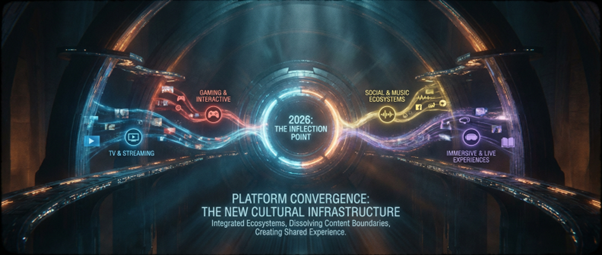
Platform Convergence: The New Cultural Infrastructure
Statistics reveal that 2026 marks what analysts describe as the “inflection point” where boundaries between content categories are dissolving. Streaming platforms are no longer simply television alternatives; they are becoming comprehensive cultural ecosystems that integrate multiple forms of entertainment and social interaction.
The Convergence Phenomenon
The data suggests several simultaneous transformations reshaping the media landscape:
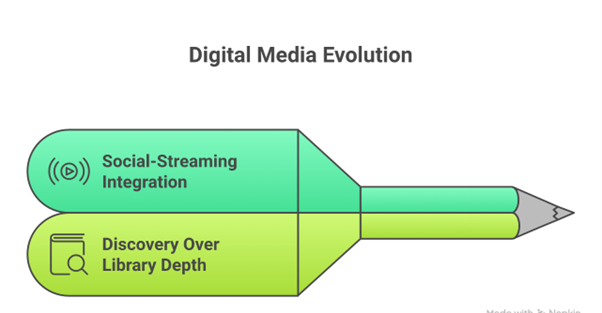
- Social-Streaming Integration: Social video platforms are eroding traditional channel boundaries, with social platforms becoming major destinations for premium content while streaming services adopt social media user experience patterns.
- Discovery Over Library Depth: The competitive advantage has shifted from content volume to content surfacing. Major streamers are deploying vertical scrolling feeds within their applications — a direct response to social media consumption patterns that prioritize endless discovery.
- Seamless Experience Demand: Consumers in 2026 expect fluid transitions between live, linear, and on-demand content without having to switch platforms.
- Two-Screen Engagement: Live events increasingly integrate social and interactive elements, creating layered viewing experiences that enhance audience participation.
This convergence represents streaming platforms simultaneously absorbing the characteristics of social media, broadcast television, and interactive entertainment. The cultural arena is not simply moving to streaming – streaming is expanding to encompass multiple cultural functions.
The Creator Economy Reshapes Content Hierarchies
Perhaps no statistic better illustrates streaming’s cultural centrality than the creator economy. The data points to a fundamental restructuring of content production: Creator Economy Metrics (2026):
- Global Creator Economy Valuation: $200+ billion;
- Primary Creator Distribution Shift: Social-first to streaming-first via AVOD/FAST channels;
- Content Integration Trend: Hollywood-creator content boundaries are increasingly blurred.
Creators are bypassing social platforms entirely to reach living room audiences directly through AVOD (Advertising-based Video on Demand) and FAST (Free Ad-Supported Television) channels. This migration indicates streaming platforms have achieved sufficient cultural legitimacy to attract talent that previously built audiences exclusively through social media.
Creators as Trend Architects
Streaming platforms treat social media not as competition but as testing grounds, identifying emerging talent, validating content concepts, and building marketing pipelines. The relationship has inverted: social media now serves streaming’s discovery needs rather than the other way around.
This integration creates a cultural production system where:
- Streaming platforms provide distribution infrastructure and monetization.
- Social platforms provide discovery and audience development.
- Creators bridge both environments as content entrepreneurs.
- Traditional entertainment entities compete for attention within this ecosystem.
AI-Driven Personalization: The Cultural Curator
Artificial intelligence has become central to streaming’s cultural impact in 2026. AI integration is evident across many digital platforms. Even large platforms like Slotozilla has collected gaming info to help users navigate entertainment options, using AI analytics to deliver better results.
AI Applications in Streaming (2026):
- Content recommendation algorithms;
- Personalized viewing experiences;
- Production optimization;
- Audience behavior prediction;
- Hyperfocal content curation.
Audiences in 2026 are increasingly selective amid platform proliferation, demanding AI-personalized experiences that efficiently surface relevant content. This selectivity creates a paradox: streaming dominates overall viewing while individual platforms compete intensely for attention within the streaming ecosystem.
The AI personalization trend has profound cultural implications. When algorithms curate individual viewing experiences, shared cultural moments become simultaneously more valuable (for platforms) and more difficult to engineer. Live sports and gaming remain key differentiators precisely because they resist algorithmic individualization.
Monetization Models Reflect Cultural Positioning
The economic structures underlying streaming platforms reveal their cultural ambitions. Hybrid monetization has become standard across the industry:
- SVOD (Subscription Video on Demand): Premium content access;
- AVOD (Advertising-based Video on Demand): Free/reduced-cost access with advertising;
- FAST (Free Ad-Supported Television): Linear-style channels without subscription;
- Layered Combinations: Multiple tiers within single platforms.
This hybrid approach allows streaming platforms to address the full spectrum of cultural consumption – from premium exclusive content to casual background viewing. This flexibility positions streaming as infrastructure rather than a mere product, capable of serving diverse audience segments and consumption contexts, much as platforms like Verdecasino have adapted their offerings to meet varied user preferences in the entertainment sector.
The Counterarguments: Limitations and Challenges
A balanced analysis requires acknowledging factors that complicate streaming’s cultural dominance:
Audience Fatigue and Selectivity
The data suggests audiences are not passively accepting streaming dominance. Viewers are increasingly discerning amid platform proliferation, creating challenges:
- Subscription fatigue across multiple services;
- Demand for hyperfocal and homegrown content;
- Preference for authenticity over production values;
- Resistance to algorithmic homogenization.
Platform Fragmentation
Streaming’s overall dominance coexists with intense competition among individual platforms. This fragmentation means:
- No single platform controls the cultural arena;
- Content licensing remains complex and contested;
- Viewers must navigate multiple services;
- Shared cultural experiences require cross-platform coordination.
Traditional Media Resilience
Research indicates streaming and linear television are converging rather than streaming simply replacing traditional broadcasting. The 41.6% viewing share retained by broadcast and cable in late 2025 represents substantial cultural influence, particularly for:
- Local news and information;
- Live events and sports;
- Older demographic segments;
- Habitual viewing patterns.
Assessment: Primary Arena With Qualifications
Can streaming platforms become the primary cultural arena in 2026? The verified data support an affirmative answer with important qualifications.
Evidence Supporting Primary Arena Status:
- Quantitative Threshold: Streaming crossing 50% of US TV viewing represents the majority cultural attention share.
- Ecosystem Expansion: Streaming platforms are absorbing functions previously distributed across social media, broadcast, and interactive entertainment.
- Economic Scale: The $670+ billion market and $200+ billion creator economy indicate substantial resource concentration.
- Talent Migration: Creators shifting from social-first to streaming-first distribution validates cultural legitimacy.
- Infrastructure Status: Hybrid monetization and AI personalization position streaming as cultural infrastructure rather than a content category.
Qualifications and Limitations:
- Convergence, Not Replacement: Streaming is absorbing rather than eliminating other media forms.
- Fragmented Dominance: Overall streaming dominance coexists with intense individual platform competition.
- Geographic Variation: US-centric data may not reflect global patterns uniformly.
- Regulatory Uncertainty: Content moderation, licensing, privacy, and antitrust considerations remain unaddressed in the current analysis.
Conclusion: The Arena Takes Shape
Streaming platforms in 2026 will be the primary but not exclusive cultural arena. This represents convergence – streaming becoming the infrastructure through which diverse content types reach audiences — rather than streaming content replacing other cultural forms.
Cultural influence in 2026 increasingly flows through streaming distribution, whether that content originates from traditional entertainment studios, independent creators, live events, or social media virality. Streaming platforms have achieved the status of cultural infrastructure: not merely a content category but the pipes through which culture flows.
For organizations, creators, and audiences navigating 2026, the evidence points to streaming literacy as essential cultural competency. Understanding algorithmic discovery, platform economics, and hybrid content ecosystems has become as fundamental as media literacy itself. The cultural arena has not simply moved to streaming – streaming has expanded to become the arena.


